Where Science Meets Beauty
What Do a Spanish Neuroscientist, a Russian Novelist, and an American Photographer Have in Common?
Let’s take a moment to talk about beauty—not the kind that fills galleries or soars through concert halls, but the kind you have to squint to see. The kind that reveals itself when you look a little closer—through a microscope, through the eye of a butterfly, through the fleeting perfection of a snowflake. The kind of beauty that makes a person stop, stare, and, if they’re lucky, spend a lifetime trying to understand it.
This story has three protagonists, three people who saw something in the world that others passed right by: Santiago Ramón y Cajal, the Spanish neuroscientist, Vladimir Nabokov, the Russian-born novelist; and Wilson Bentley, the American photographer. They came from different countries, lived in different times, worked in different fields, and never met. Yet they shared the same impulse—to look closer, to capture what others overlooked. And in doing so, they didn’t just find beauty; they helped us understand the world a little more clearly.
They didn’t just study the world. They saw it. And perhaps, by the time we’re done here, you’ll see it a little differently too.
Now, let’s begin.
Enter Santiago Ramón y Cajal. Imagine a young doctor in Spain, the year 1870. Not yet a renown scientist, not yet Nobel-worthy, just a man peering through a microscope. Ramón y Cajal would come to be called the father of modern neuroscience, yet what makes him remarkable for our story is this: he showed us beauty at the smallest scale imaginable. Through his eyes, the brain was not a lump of gray matter, but a vast forest of cells, full of structure, order, and elegance.
Though initially trained in medicine, it was the hidden landscapes of the brain that soon called to him. Entrepreneurial and self-motivated, he started in a home laboratory, equipped with microscopes, chemical stains, pencils, and relentless determination. Meticulously peering into countless thin slices of nervous tissue and aided by techniques he had refined with equal care, he transformed each fragment into a glimpse of the brain’s hidden intricacy.
To discover was, for Cajal, also to draw. Nearly 30,000 images flowed from his hand: delicate lines in pencil, India ink, and watercolor washes. They were landmarks of science, yes, precise and meticulous, but they were also works of art. His dendrites branched like thorns, axons stretched and arched, forming intricate, living patterns across the page. One whimsical sketch, showing a damaged Purkinje neuron as a swimming penguin, captures his playful eye for detail. For Ramón y Cajal, drawing was not just recording. It was thinking. Each line was both an observation and an argument, shaped by aesthetic choices as much as scientific ones.
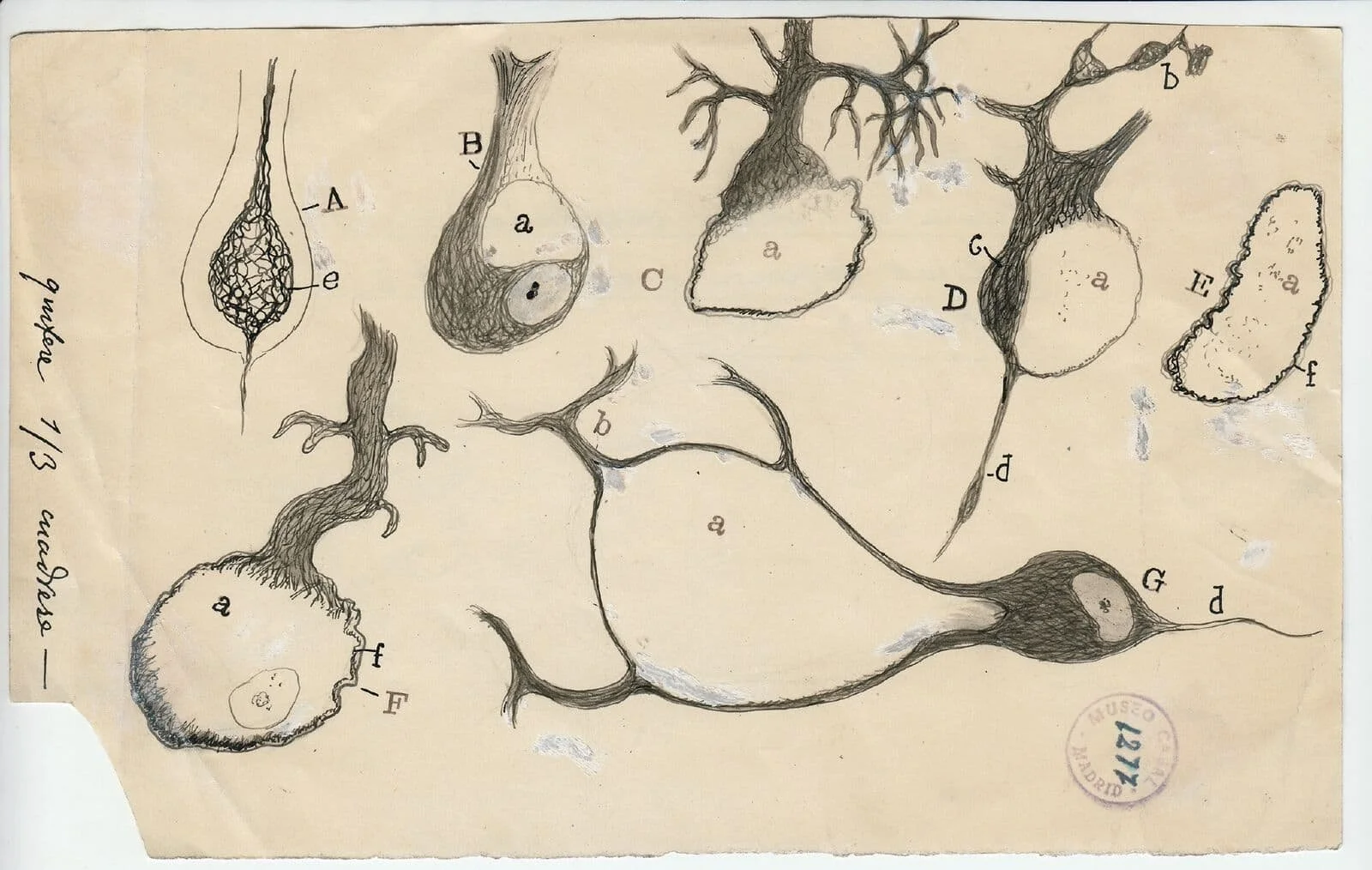
Santiago Ramón y Cajal, Injured Purkinje Neurons of the Cerebellum, 1914. Cajal Institute (CSIC), Madrid. Public domain.
Now, consider Vladimir Nabokov. You know him, of course, as the author of Lolita. “Lolita, light of my life, fire of my loins.” Yes, that Lolita. But Nabokov was more than the writer behind complex, influential, yet often scandalous works of literary fiction. Here’s the twist: he was also a lepidopterist, a butterfly scholar. He published scientific papers, held a research fellowship at Harvard, and left behind copious laboratory notes and meticulous technical illustrations. For him, science and art were never apart—they lived together on the same continuum.
You can almost see him, Nabokov, the devoted butterfly hunter, leaning over the microscope. Hours pass—sometimes fourteen at a stretch—eyes straining to study and capture the delicate morphology of each specimen. With pencil in hand—or more often a camera lucida—he traced over a thousand illustrations: veins, scales, folds, each line drawn with the utmost care. To most, just another butterfly. To him, each one was singular. And he wasn’t content to simply observe; he wanted to understand. He classified species, erected new genera, named species, traced evolutionary relationships, and proposed hypotheses that would lie in wait, only to be vindicated decades later through DNA analysis.
And in all this meticulous study, there was also an artistry. Nabokov arranged forms with an eye for balance and composition, noticing symmetries and asymmetries, and through it all, a quiet sense of wonder shone in every line, making his scientific drawings compelling beyond their technical value. Precision and beauty were inseparable. To look closely, to measure, to classify, was also to create—to render the invisible patterns of nature visible, vivid, and alive.
Let’s transport ourselves now to a farm in Vermont. Cold, long winters. Snow falling by the thousands. And there’s Wilson Bentley—the boy who would grow up to hold winter in his hands, one perfect, unique snowflake at a time. Each one delicate, fleeting, gone before he could truly see it. So he found a way to catch them. Back in 1886, with a microscope and a camera, Bentley became the first to photograph a snowflake, catching its six-fold symmetry before it melted away. Dozens, then hundreds of them—astonishingly showing that no two were alike. He called them “tiny miracles of beauty,” and he was right.
Bentley wasn’t a professor, nor a man of science by training. He was a farmer, homeschooled in a small Vermont town, soft-spoken, shy, a little unsure of himself. He set about learning the secrets of snowflakes through trial and error. First he tried sketches, but soon turned to photomicrographs to capture the brief, exquisite shapes before they melted. Images vanished, plates spoiled, yet he pressed on—until, at last, success: that fleeting wonder transformed into a careful, deliberate science of snow.
Each of Bentley’s snowflake photographs was a small masterpiece, exquisite in its detail and fragility. And yet they carried weight far beyond their beauty. Bentley’s work traveled far: his images and observations reached universities worldwide; he published in academic journals and magazines; he ventured hypotheses that advanced meteorology; and he even wrote a book still in print today. All from that Vermont farm, where winter gave him his subject, and his patience and awe turned fleeting wonder into enduring science and beauty.
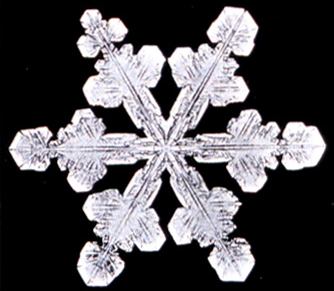
Wilson A. Bentley, Snow Crystal, Plate XIX from Monthly Weather Review, 1902. NOAA Historic NWS Collection. Public domain.
So, what do the Spanish neuroscientist, the Russian novelist, and the American photographer have in common? They saw the world differently—and more deeply. Not just as it superficially appeared, but as it truly revealed itself. Traced in ink. Caught on a pin. Frozen in a pane of glass. In their pursuit, they left behind something more: proof that science is not just about facts and figures, but about wonder. About paying attention. About looking a little closer. Because in the end, the world is full of beauty. The question is: will we see it?